
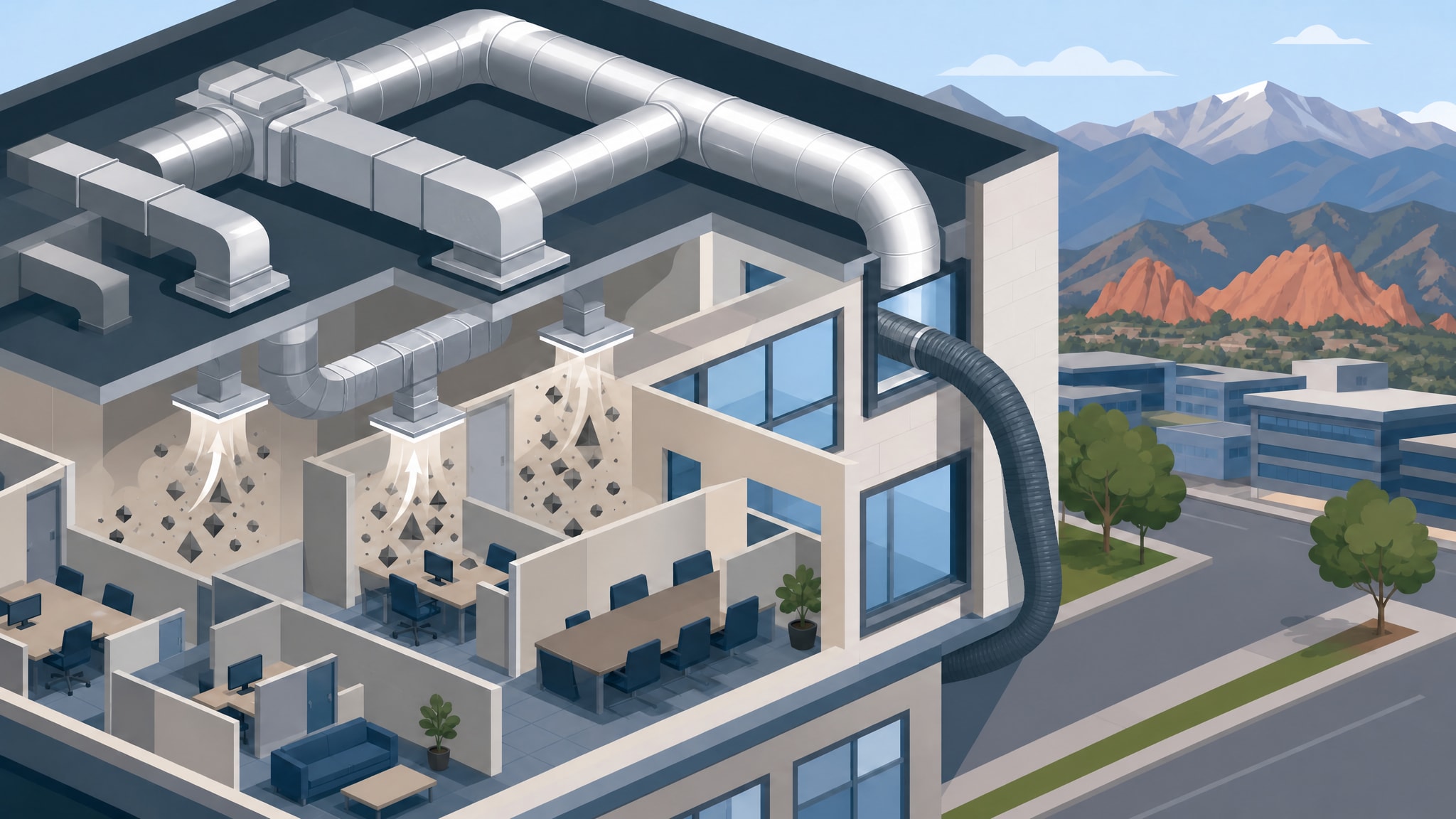
Denver and Colorado Springs property managers face a distinct set of challenges keeping indoor air clean in commercial buildings. High-altitude dust, seasonal wildfire smoke, and heavy HVAC use combine to build up contaminants that standard janitorial services can’t touch. Residential cleaning is about single-family comfort. Commercial air duct cleaning in Colorado Springs is a different job, it takes industrial-grade equipment and real logistical planning to handle office complexes and multi-unit properties without shutting a business down.
You need a partner who understands both the mechanics of large-scale HVAC systems and the tenant relations side of property management. Monster Vac has completed over 300,000 air duct cleanings across Colorado using truck-mounted vacuum systems built for exactly this level of demand. This guide walks through the pricing variables, the technical process, and the scheduling strategies that define professional commercial duct cleaning in the Pikes Peak and Denver region.
Why Denver and Colorado Springs Commercial Buildings Need Scheduled Duct Cleaning
Commercial buildings pack in more people and run their HVAC systems longer than a house does, so contaminants build up faster. Your building’s HVAC system works like a giant filter, and eventually it gets saturated with particulate if nobody maintains it.
Local Climate Impacts on Office HVAC Systems
The Pikes Peak and Denver region has its own environmental stressors that speed up duct contamination well beyond what national averages suggest. Dry winters kick up fine mineral dust that gets pulled into intake systems. Summer wildfire seasons add microscopic ash that slips past standard MERV filters and embeds deep in the trunk lines. Mix that with office-generated pollutants, toner dust, paper fibers, skin cells, and you get a dense residue inside your ductwork that restricts airflow and drags down system performance over time.
That local reality means you can’t run on a maintenance schedule built for coastal or humid climates. Buildings in Denver and Colorado Springs need more frequent inspections and more aggressive cleaning protocols to deal with the specific abrasive, sticky nature of high-desert contaminants settling into mechanical components.
Health and Compliance Standards for Tenants
Tenant retention increasingly comes down to demonstrable indoor air quality, not just temperature control. You have to balance OSHA expectations for workplace safety against a simpler reality: visible dust or a persistent odor triggers lease disputes and health complaints whether or not it crosses a regulatory line. Clean ductwork is verifiable proof of proactive facility upkeep, and that protects you during lease renewals and liability discussions.
Neglecting this maintenance creates compounding risks that go well beyond simple discomfort.
Over 1,700 five-star Google reviews back up Monster Vac’s commercial and residential work across the Colorado Springs and Denver metro areas, because tenants and building owners can tell the difference between someone wiping vent covers and a genuine system restoration. Handle air quality proactively and you avoid the emergency remediation costs and tenant turnover expenses that follow a documented health incident or a failed inspection.
Commercial Duct Cleaning Pricing Factors in Denver and Colorado Springs
Commercial duct cleaning pricing per square foot involves far more variables than a residential quote, because no two commercial HVAC layouts look the same. Expect a real assessment, not a flat-rate number over the phone, accurate pricing depends on your system’s architecture and how hard it is to access.
Square Footage vs. Vent Count Estimation
Commercial pricing diverges from residential benchmarks fast, because scale adds complexity a simple square-foot number can’t capture. Homeowners often lean on per-vent pricing benchmarks for Denver and Colorado Springs to budget for house cleaning, but commercial facilities get priced on duct run length, trunk line diameter, and the number of mechanical units serving each zone. A warehouse with open ceiling space and straightforward duct runs costs less per square foot than an office building full of dropped ceilings, fire dampers, and tight access points that eat extra labor hours.
Your quote will reflect those structural realities, not a simplified area measurement.
Rooftop Units and Multi-Zone System Variables
Multi-unit air duct cleaning in Denver and Colorado Springs often involves rooftop units, which need specialized safety gear and weather-dependent scheduling. Each RTU is its own cleaning project, with its own containment setup, agitation requirements, and debris path, more labor-intensive than a ground-level mechanical room. Multi-zone systems add another layer: technicians have to isolate and clean each zone in sequence to avoid cross-contamination, which stretches out the timeline and demands precise damper work throughout.
These mechanical configurations are what determine crew size and equipment deployment.
Additional Services: Coil and Blower Fan Cleaning
Comprehensive commercial HVAC cleaning in Colorado Springs goes beyond the ductwork itself. Full-system commercial cleaning includes blower fans, evaporator coils, and furnace cabinets, not just duct interiors, to restore full HVAC performance. Skip commercial evaporator coil cleaning in Colorado Springs and Denver and you leave the main source of airflow restriction and microbial growth untouched. The duct cleaning ends up incomplete and short-lived.
Budgeting for a partial cleaning saves money upfront. It also guarantees recontamination and continued energy waste.
Monster Vac’s Truck-Mounted Commercial Cleaning Process
Our methodology is built around extraction power and systematic thoroughness, not speed. Commercial systems need industrial-scale negative pressure to dislodge decades of accumulated debris. Portable units marketed for commercial use don’t sustain the CFM it takes to pull heavy particulate through long trunk lines and vertical risers.
High-Power Negative Air Containment
Truck-mounted negative air machines deliver significantly higher CFM extraction than portable units, which means deeper debris removal from commercial trunk lines, where most of the contamination hides. We build negative pressure across the entire duct network before any agitation starts, so the airflow direction is controlled and liberated contaminants can’t escape into occupied space during the work. That containment is non-negotiable in an occupied commercial building, where cross-contamination could trigger health complaints or damage sensitive equipment next door.
The vacuum truck stays outside while sealed hoses connect directly to your main trunk lines, either through existing access panels or through openings we cut and then seal permanently after service.
Full-System Agitation and Debris Removal
Negative pressure alone won’t remove adhered biofilm or compacted dust that’s bonded to duct surfaces over years. Technicians use pneumatic whips, rotary brushes, and compressed air tools matched to your duct material and contamination profile to mechanically break debris loose while the vacuum keeps extracting. Agitation and extraction happen at the same time, so loosened contaminants go straight to the collection tank instead of resettling elsewhere in the system, a common failure point with weaker portable setups.
We clean supply and return trunks, branch lines, diffusers, grilles, and every accessible mechanical component in one continuous workflow that prevents recontamination.
Post-Cleaning Verification and Documentation
Property manager HVAC cleaning services need to come with verifiable proof of the work, both for compliance records and for tenant communication. We provide before-and-after photos of representative sections, a service checklist detailing every component cleaned, and recommendations for ongoing maintenance based on what we actually found. This documentation gives you concrete evidence to share with stakeholders, and it supports warranty claims or insurance reviews tied to indoor air quality improvements.
Verification is what turns the service from an invisible expense into a documented asset improvement.
Scheduling Around Tenants: Minimizing Business Disruption
Commercial duct cleaning has to work around active business operations, not force tenants to relocate or shut down. You can get comprehensive cleaning done without disrupting tenants through phased zone isolation and after-hours work windows built around your building’s occupancy patterns.
Proactive coordination is what keeps maintenance from turning into a tenant relations problem. Our crews work nights, weekends, or holidays when needed to handle the noisy or intrusive phases while offices sit empty, then do the quieter work during business hours behind proper containment barriers. Knowing typical project timelines for duct cleaning helps you set realistic expectations with tenants and avoid conflicts that delay the job or generate complaints.
A phased approach lets multi-tenant buildings stay fully occupied throughout the project, isolate one zone, restore it, then move to the next.
Residential vs. Commercial Air Duct Cleaning Differences
Hire a residential cleaner for a commercial property and you’re exposed to weaker equipment, thinner insurance coverage, and methods that can’t touch industrial-scale contamination. The key differences between residential and commercial cleaning come down to equipment capacity, crew training, safety protocols, and documentation standards, the things that separate specialized contractors from generalist home service providers.
Residential trucks typically max out around 3,000 CFM. Our commercial units sustain significantly higher extraction, which large-diameter metal ductwork and complex zoning systems require. Commercial crews carry liability insurance scaled to commercial property values and know OSHA-compliant safety practices for mechanical rooms, rooftops, and work around active electrical panels. Try to save money with a residential outfit on a commercial job and you’ll usually end up with incomplete cleaning, damaged infrastructure, or liability exposure that costs far more than what you saved.
Specialized commercial service tiers exist because the job is different in scope, risk, and required expertise and NADCA Standards.
Proactive Maintenance Contracts for Property Managers
Wait for visible contamination or tenant complaints, and you guarantee higher remediation costs and faster equipment wear. A preventive maintenance schedule based on actual building usage protects your capital investment and stabilizes operating costs over the long run.
Recommended Frequency for Offices and Multi-Family
Maintenance intervals should track filtration efficiency, occupancy density, and local conditions, not an arbitrary date on a calendar. Standard office buildings with MERV 8-11 filtration typically do fine with professional cleaning every three to five years. Medical facilities, restaurants, or buildings near construction zones may need annual or biannual service to keep air quality where it should be. Multi-family properties land somewhere in between, depending on pet policies, smoking restrictions, and turnover, all of which shift how fast contaminants build up in individual units and common-area systems.
Let your inspection reports drive schedule adjustments based on what’s actually accumulating, not a fixed assumption.
Long-Term ROI Through Energy Efficiency
Clean ductwork reduces static pressure throughout your HVAC system, so fans move the same air volume with less energy and less mechanical strain. Removing debris from coils, fans, and duct surfaces improves heat transfer and reduces fan motor amperage draw, which shows up as lower utility bills that offset the cost of cleaning over time. Building owners who treat duct cleaning as preventive maintenance rather than reactive repair tend to report longer equipment lifespan and fewer mid-season breakdowns, the kind that disrupt tenants and drain emergency repair budgets.
Energy savings compound year over year as clean systems run closer to their original design specs.
Requesting a Commercial Quote from Monster Vac
Accurate commercial estimates depend on specific building information, which cuts down on unnecessary site visits and guesswork. Have floor plans showing duct layouts, mechanical unit locations, and access points ready, along with your preferred service windows and any tenant coordination requirements, before you reach out. Having this ready speeds up the quoting process and signals that you’re a property manager who prepares.
Monster Vac brings decades of Colorado-specific experience to every commercial assessment. When you request a commercial cleaning quote, you get a detailed proposal grounded in an actual system evaluation, not a generic square-footage multiplier that hides change orders down the line. Our track record, over 300,000 completed cleanings, means we’ve run into nearly every commercial HVAC configuration in the Pikes Peak and Denver region, and we can spot trouble before it turns into a costly surprise mid-job.


